
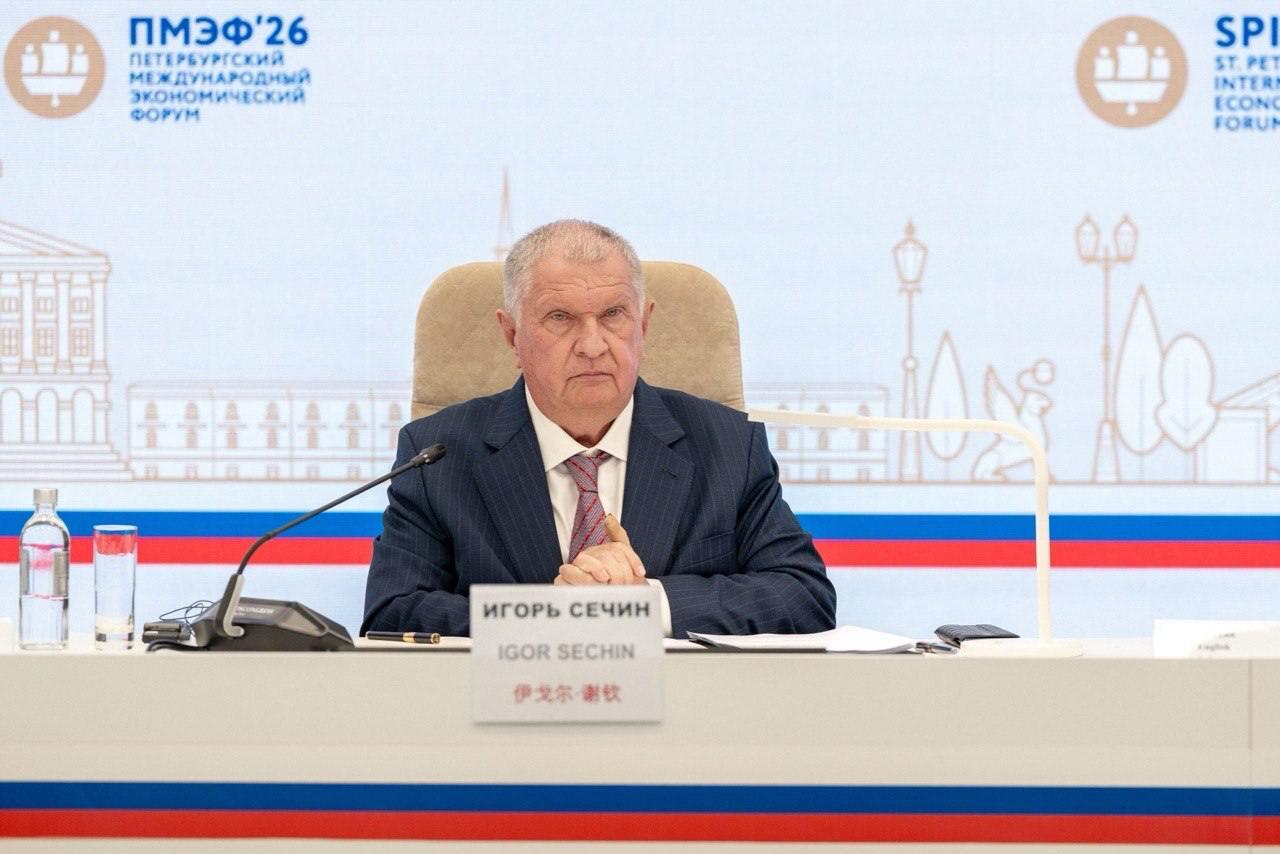
The global economy is entering a period of strategic risks, said Igor Sechin, Chief Executive Officer of Rosneft Oil Company and Executive Secretary of the Presidential Commission on the Development Strategy of the Fuel and Energy Sector and Environmental Security, during the Energy Panel of SPIEF 2026.
In his keynote report, “The Beginning of the End or the End of the Beginning: What Remains at the Bottom of Pandora’s Box?”, Sechin addressed the consequences of sanctions, the conflict in the Middle East, and the transformation of the global economy. He also highlighted India’s growing role as a key driver of global energy demand.
According to projections by the International Energy Agency, India’s electricity consumption is expected to increase by 80% by 2035, reaching nearly 3,000 TWh and approaching the current level of the European Union. India is also set to play an increasingly important role in the oil market, accounting for approximately half of global oil demand growth over the next decade. Its oil consumption is projected to rise by 44%, reaching almost 8 million barrels per day by 2035, while global demand is expected to grow by only 5%.
Sechin noted that tensions in the Strait of Hormuz and emerging geopolitical risks could negatively affect the development needs of the Indian economy. At the same time, these challenges create incentives to seek long-term energy security solutions. Against this backdrop, Russia’s economic partnership with India provides reliable oil supplies. According to Sechin, this cooperation is already generating substantial economic benefits. Since April 2022, the cumulative economic effect for China and India has exceeded $40 billion.
A significant portion of the report focused on the Middle East. In Sechin’s view, the escalation of the regional conflict has become a precursor to a broader global crisis. In addition to oil and gas shipments, the Strait of Hormuz is a key route for fertilizer exports, meaning disruptions could pose risks to global food markets.
The Hormuz crisis has also exposed the vulnerability of global logistics and major transportation corridors. Sechin described the United States as the primary beneficiary of the situation, as American oil and gas companies have gained opportunities to increase exports and generate additional profits.
Under these circumstances, the Northern Sea Route is becoming increasingly important. According to the Rosneft CEO, it can provide global trade with alternative transportation solutions, reduce delivery times by 1.5 to 2 times, and lower transportation costs by 20–30%.
Another major risk identified by Sechin is the underinvestment in the energy sector. He argued that expectations of an accelerated energy transition and the neglect of energy security concerns have led to reduced investment in the production and processing of fossil fuels.
The Rosneft chief also pointed to a large-scale shift of capital from the real economy into the financial sphere. According to his estimates, the volume of what he described as “fictitious capital” now exceeds $500 trillion, nearly five times global GDP. The continued use of the U.S. dollar as a sanctions instrument is contributing to the growing role of alternative assets. Sechin stated that if Russia had started increasing the gold share of its reserves earlier, the resulting gains from gold price appreciation could have exceeded $400 billion.
Addressing the militarization of the global economy, Sechin noted that military spending has been rising for eleven consecutive years. In his view, a new triad of beneficiaries is emerging: the defense industry, high-tech corporations, and the financial sector. Together, these actors concentrate a significant share of global investment resources and increasingly influence decisions affecting the world economy. He also argued that military force has become an additional instrument of economic and political pressure. Separately, Sechin stated that Germany has begun reorienting its economy toward military production.
The report devoted considerable attention to artificial intelligence. According to Sechin, a financial bubble is forming around the industry, while the expected economic benefits of AI adoption have yet to be confirmed by statistical evidence. At the same time, AI development is driving structural growth in electricity consumption. Sechin described this process as the global economy’s transition “from molecules to electrons.” Global electricity demand is projected to increase by nearly 40% by 2035.
As an example of successful long-term strategic planning, Sechin pointed to China, which he believes is better prepared than any other country for the consequences of the Hormuz crisis. China currently leads in the development of nuclear power, electricity grids, energy storage systems, and the construction of new generation capacity. The country’s installed power generation capacity is more than three times that of the United States.
Turning to the oil market, the Rosneft CEO stated that OPEC+ has lost part of its influence, while the combined production of alliance members complying with output restrictions now accounts for less than one-third of global oil production. During the period of production cuts, Russia reduced its oil output by 1.5 million barrels per day. Restoring these volumes, Sechin said, would require at least RUB 10 trillion in investment.
At the same time, he emphasized that the oil industry remains a key contributor to the Russian economy. In 2025, total tax revenues generated by the oil and gas sector and related industries amounted to approximately RUB 17 trillion, representing nearly one-quarter of consolidated budget revenues.
Concluding his remarks, Sechin stated that at the bottom of Pandora’s box, the global economy will ultimately discover a shortage of the resources that will shape its future. He stressed that Russia remains a guarantor of global energy security and cannot be excluded from international energy supply chains.
